ENGINEERING CONTEXT
Backend Infrastructure
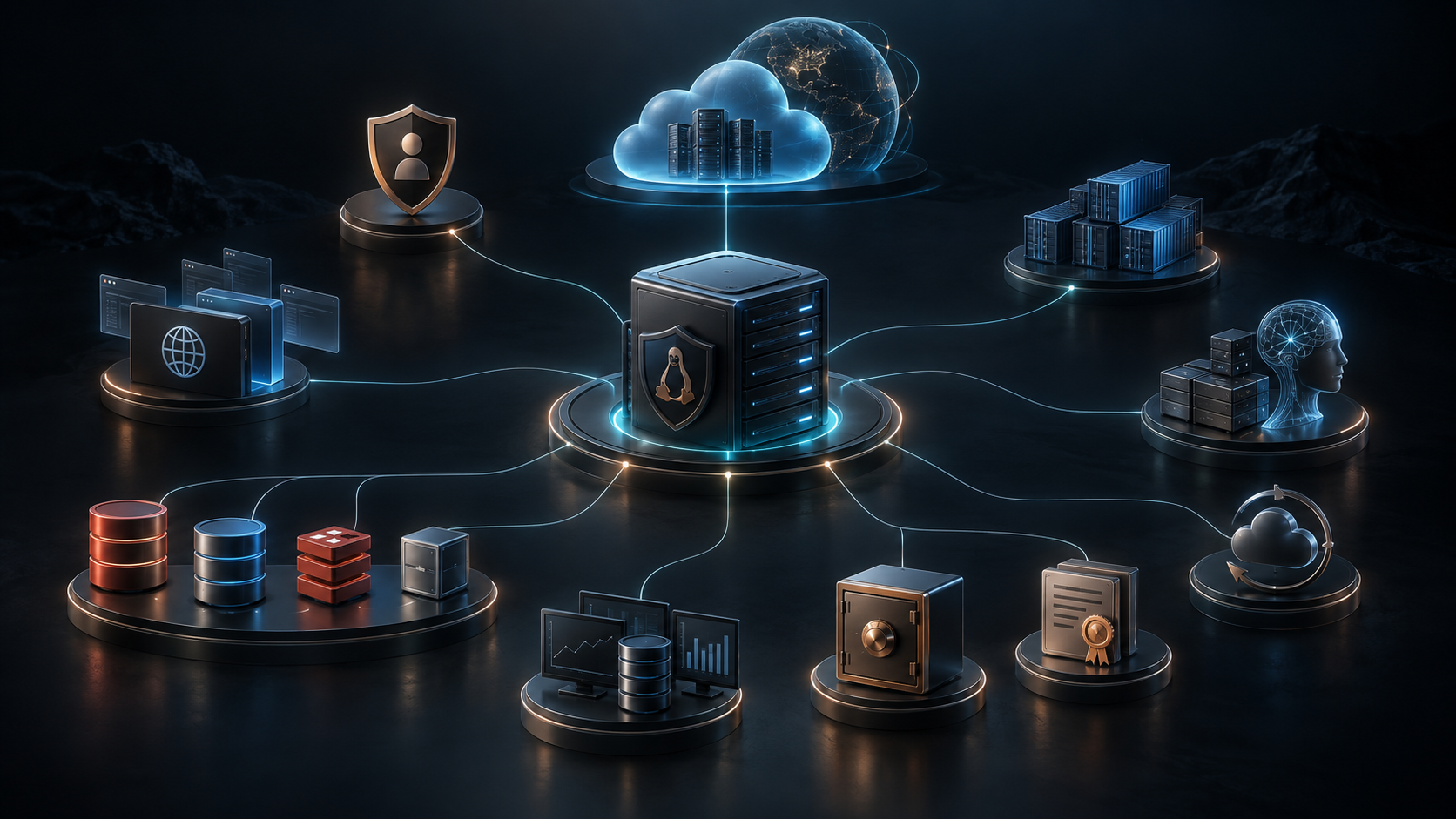
A sanitized view of the compute, ingress, application, AI, data, security and operational layers behind the DeepSec demonstration estate.
ESTATE AT A GLANCE
One connected operating environment
Identity, applications, AI services, databases and evidence remain distinct layers, connected through a controlled runtime and ingress foundation.
INFRASTRUCTURE DOMAINS
Six views of the same estate
The workbook remains the detailed source. This page groups its operational content into a smaller set of understandable domains.
AIApplications and AI runtimesThe deployed application, agent, orchestration and model-serving surfaces.
- Ten public application experiences
- OCI and local inference paths
- PAF, LiteLLM, Ollama and MCP integrations
IDIdentity and data securityHow enterprise identity reaches the application and becomes database-enforced authorization.
- OCI IAM authentication
- Application identity and end-user context
- DeepSec DATA ROLE and DATA GRANT controls
VMCompute and ingressThe operating environment that accepts traffic and runs the estate.
- Linux compute and storage
- DNS and Nginx ingress
- Services, listeners and automation
DBData platformsThe databases and supporting stores used by applications, agents and the Control Tower.
- Oracle Database estate
- PostgreSQL and Redis services
- SQLite and application-specific stores
OPOperations and evidenceThe surfaces used to observe, validate and recover the environment.
- Monitoring and OCI logging
- Evidence and forensic records
- Certificates, wallets and lifecycle controls
RVReadiness and reviewKnown observations that require periodic operational or manual validation.
- Coverage and change history
- Capacity and recovery observations
- Reserved or inactive integration paths
APPLICATION RUNTIME MAP
Ten experiences, one shared foundation
Each application uses a distinct model, tool or security pattern while sharing the core identity, ingress, compute and evidence layers.
01GlobalPaySecure Payroll Portal
- Experience
- Business portal
- Intelligence
- No AI model
- Data boundary
- Oracle Database with DeepSec
02Payroll AI Assistant
- Experience
- Conversational application
- Intelligence
- Local Gemma through Ollama
- Data boundary
- Governed context
03Payroll SQL Agent
- Experience
- Tool-using agent
- Intelligence
- Local Llama through Ollama
- Data boundary
- Bounded SQL tools
04PAF Orchestrator
- Experience
- Hybrid agent workflow
- Intelligence
- Private Agent Factory and local inference
- Data boundary
- Application-side governed access
05OCI Responses Agent
- Experience
- Cloud agent
- Intelligence
- OCI Responses API and GPT-OSS
- Data boundary
- Deterministic intent mapping
06Meridian HR
- Experience
- Negative-control agent
- Intelligence
- OCI enterprise inference
- Data boundary
- Ordinary database access
07Meridian Guard
- Experience
- Positive-control agent
- Intelligence
- OCI enterprise inference
- Data boundary
- Database-enforced DeepSec
08Meridian Multi-Cloud
- Experience
- Provider-neutral agent
- Intelligence
- Semantic routing and multiple model providers
- Data boundary
- MCP-grounded access
09Cockpit Base
- Experience
- AIDP agent
- Intelligence
- Enterprise agent and remote MCP tools
- Data boundary
- Negative-control lakehouse path
10Cockpit Guard
- Experience
- Protected AIDP agent
- Intelligence
- Enterprise agent and remote MCP tools
- Data boundary
- DeepSec-protected lakehouse path
DATA ESTATE
Purpose before implementation detail
The public view explains why each platform exists. Connection details and administrative identifiers remain inside the controlled inventory.
Oracle Database
Application data, enterprise identity context and DeepSec enforcement
PostgreSQL
Control Tower knowledge, retrieval metadata and operational state
Redis
Low-latency runtime and session support where required
SQLite
Embedded application and tool state
Supporting stores
Files, model assets, evidence and workload-specific repositories
OPERATIONAL POSTURE
Verified facts and visible follow-up
Status reflects the sanitized inventory snapshot. It records evidence and review needs without publishing sensitive operational details.
Ingress coverage
VerifiedPublic routes map to documented application services.
Runtime inventory
VerifiedServices, containers and application dependencies are catalogued.
Data estate
VerifiedPrimary database and supporting-store roles are documented.
Observability
VerifiedMonitoring, logging and evidence surfaces are represented.
Manual validation
TrackedSelected cloud resources and reserved integrations require owner confirmation.
Recovery readiness
ReviewLifecycle procedures exist and should remain part of periodic DBA and platform validation.
EVIDENCE AND HANDOVER
Public understanding, controlled operations
The public portal describes the estate. The master inventory remains the source for authorized engineering handover and operational verification.
Sanitized by design
Architecture purpose, service relationships, platform roles, operational coverage and evidence concepts.
Restricted to authorized operators
Administrative endpoints, credentials, identity registers, internal identifiers, connection details and verification commands.
Inventory reference: 27 September 2026 · Read-only evidence collection · Sensitive values excluded